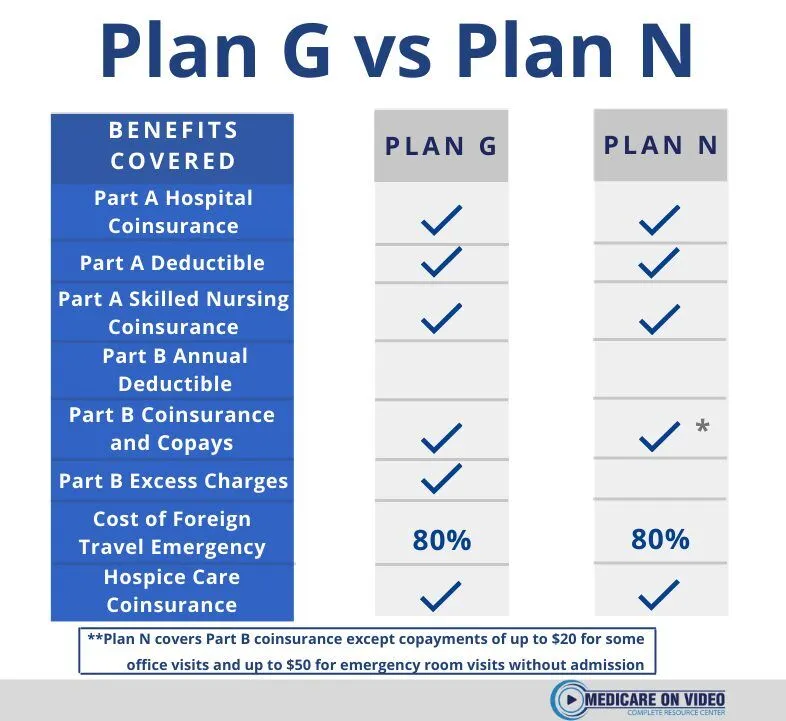
Plan G vs Plan N — when choosing a Medicare Supplement plan in Arizona, this is the comparison that matters most. Both plans are popular. Both cover most of what Original Medicare leaves behind. However, they handle office visits and cost-sharing differently. In this guide, you’ll see exactly how Plan G vs Plan N compares — so you can choose the right plan for 2026.
What Plan G and Plan N Both Cover
First, it helps to know what these two plans share. Both Plan G vs Plan N cover the following:
Medicare Part A coinsurance and hospital costs
Medicare Part A deductible ($1,736 in 2026)
Medicare Part A hospice care coinsurance
Skilled nursing facility coinsurance
Medicare Part B coinsurance — with one key difference explained below
Foreign travel emergency care up to plan limits
In addition, both plans require you to pay the Part B deductible ($283 in 2026) once per year. After that, coverage kicks in. So far, they look nearly identical. The differences, however, matter a lot depending on how often you use your insurance.
Plan G vs Plan N: The Key Differences
Plan G covers 100% of your Medicare Part B coinsurance. Therefore, after your Part B deductible, you owe nothing for covered outpatient care.
Plan N covers most Part B coinsurance — but not all. Specifically, Plan N has these out-of-pocket costs:
Up to $20 copay per office visit
Up to $50 copay per emergency room visit (waived if admitted)
Part B excess charges — if a doctor doesn’t accept Medicare assignment, you pay the difference between their rate and Medicare’s approved amount
Most Arizona doctors accept Medicare assignment. As a result, excess charges rarely come up. However, the office visit copays do add up if you see doctors often. That’s the core of the Plan G vs Plan N decision.
How Premiums Compare in Arizona
Plan N typically costs $20–$40 less per month than Plan G in Arizona. Therefore, over a full year, you could save $240–$480 in premiums with Plan N.
However, that savings only holds if your copays stay below the premium difference. For example, if you visit the doctor six times per year, that’s up to $120 in Plan N copays. In that case, Plan N still wins on price. On the other hand, frequent visits or ER trips can close the gap quickly.
The bottom line: run the numbers for your situation. That’s exactly what I do for clients at no charge.
Who Should Choose Plan G
Plan G makes the most sense in these situations:
You have ongoing health conditions or frequent doctor visits
You want predictable costs with no copay surprises
You travel often and may see out-of-network providers
You simply want the most comprehensive coverage available
In short, Plan G is the “set it and forget it” option. After your Part B deductible, your costs are done for the year.
Who Should Choose Plan N
Plan N works well in these situations:
You are generally healthy and see a doctor only a few times per year
You want to lower your monthly premium
Your doctors all accept Medicare assignment
You are comfortable paying a small copay at visits
Furthermore, Plan N is a smart choice for people who want solid Medigap coverage without paying for benefits they rarely use.
Plan G vs Plan N: Carriers in Arizona
Both plans are standardized by the federal government. Therefore, the benefits are identical no matter which insurance company you buy from. What differs between carriers is the monthly premium and the company’s rate history.
Whether you choose Plan G or Plan N, timing is critical. When you first enroll in Medicare Part B, you receive a 6-month Medigap open enrollment window. During this period, insurance companies cannot deny you or charge more based on health history.
After this window closes, however, insurers can use medical underwriting. Consequently, pre-existing conditions could affect your options or your premium. This window only happens once. Therefore, if you’re turning 65, get your Medigap plan in place before your birthday month.
I’m Andy Orlikoff, an independent Medicare Supplement broker in Surprise, AZ. I’ve been helping Arizona residents compare Plan G vs Plan N and enroll in the right coverage since 2004. I don’t sell Medicare Advantage — just honest Medigap guidance at no cost to you.
I’ll pull side-by-side quotes from multiple carriers and walk you through the numbers. You decide what fits. I handle the enrollment.
Medicare Advantage plans — also called Medicare Part C — are heavily marketed to Arizona seniors every fall. The ads make them sound like a no-brainer — low premiums, extra benefits, simple coverage. However, after more than 20 years helping Arizona residents navigate Medicare, I’ve seen the disadvantages of Medicare Advantage plans up close. Here are 9 things the ads don’t tell you.
1. Disadvantages of Medicare Advantage: Narrow Provider Networks
One of the biggest disadvantages of Medicare Advantage is the restricted network. Most plans only cover care from in-network providers. If your doctor isn’t in the plan’s network, you pay out-of-pocket — or find a new doctor.
Original Medicare lets you see any doctor in the U.S. who accepts Medicare. That’s the vast majority of physicians. Medicare Advantage plans can’t say the same.
2. Prior Authorization Requirements
Before Medicare Advantage pays for many procedures, the insurance company must approve them first. This process — called prior authorization — can delay care by days or weeks. In some cases, approval is denied entirely.
According to Medicare.gov, Original Medicare does not require prior authorization for most services. Your doctor decides what care you need, and Medicare covers it.
3. Higher Out-of-Pocket Costs When You’re Sick
Medicare Advantage plans often advertise low or zero premiums. However, when you actually use the plan, costs can add up quickly. Copays for specialist visits, hospital stays, and procedures can push your annual out-of-pocket costs to $8,000–$10,000 or more.
With a Medicare Supplement (Medigap) Plan G, your only cost is the Part B deductible — $283 in 2026. After that, you pay nothing for covered services the rest of the year.
4. Plans Change Every Year
Medicare Advantage plans can change their benefits, networks, copays, and drug formularies every January 1st. A plan that worked well for you in 2025 may look very different in 2026. Your doctors may drop out of the network. Your medications may no longer be covered at the same cost.
Medigap plans are standardized and stable. Plan G benefits are set by the federal government and don’t change from year to year.
5. The One-Way Door Problem
This is the most serious of all disadvantages of Medicare Advantage that most people don’t discover until it’s too late. If you enroll in Medicare Advantage and later want to switch to a Medigap supplement plan, you may need to pass medical underwriting.
Insurance companies can deny you Medigap coverage — or charge significantly higher premiums — based on your health history. Once you’re locked into Medicare Advantage with serious health conditions, switching may no longer be possible.
6. Limited or No Coverage Outside Your Service Area
Most Medicare Advantage plans only cover non-emergency care within their local service area. If you travel frequently, spend time in another state seasonally, or want access to specialists in other cities, Medicare Advantage can leave you uncovered.
Original Medicare — and any Medigap plan — covers you at any Medicare-accepting provider nationwide. No zip code restrictions.
7. Mayo Clinic and Major Hospitals Often Not Included
Mayo Clinic Arizona does not accept most Medicare Advantage plans. Neither do many other major specialty hospitals. If you’re diagnosed with a serious condition and want access to the best specialists in the country, Medicare Advantage may not get you there.
Original Medicare is accepted at Mayo Clinic and most major medical centers across the U.S.
8. “Extra Benefits” Are Often Overstated
Medicare Advantage plans advertise dental, vision, hearing, gym memberships, and other extras. In practice, these benefits are often limited — small dollar amounts for dental, narrow networks for vision, or gym programs that require specific facilities.
Many people find these add-ons don’t offset the higher costs they face when they need real medical care.
9. Smaller Networks in Rural Arizona
If you live outside the Phoenix metro — in rural Arizona, smaller cities, or communities far from major medical centers — Medicare Advantage networks may offer very few in-network options. Driving long distances to see an in-network provider, or paying out-of-network rates, becomes a regular reality.
Original Medicare works everywhere there’s a Medicare-accepting doctor. In rural areas, that’s often the only practical choice.
What to Consider Instead of Medicare Advantage
Understanding the disadvantages of Medicare Advantage before you enroll can save you from a very difficult situation down the road.
I’m Andy Orlikoff, an independent Medicare broker based in Surprise, AZ. I don’t sell Medicare Advantage. After 20+ years watching what happens when people need their coverage most, I recommend Medicare Supplement Plan G to nearly every client who qualifies.
I’ll compare rates from multiple carriers, explain your options clearly, and help you enroll — at no cost to you. Your premium is the same whether you use a broker or go direct.
As an independent insurance broker helping Arizona retirees since 2004, I’m seeing a clear pattern this year: more people are asking whether they should stay with Medicare Advantage or switch to something better. After reviewing what’s happening with Advantage plans in 2026, I’m recommending Medicare Supplement Plan G to virtually every client who qualifies. Here’s why.
Why I’m Recommending Medicare Supplement Plan G in 2026
Medicare Advantage plans have been losing ground. In 2026, several major carriers cut benefits, raised copays, and reduced networks. According to Medicare.gov, you can switch plans during open enrollment if yours no longer works for you. A JAMA study found that 1 in 10 Medicare Advantage members was forced off their plan entirely. Meanwhile, Medicare Supplement Plan G hasn’t changed — and that stability is exactly what my clients need.
No Prior Authorization With Medicare Supplement Plan G
One of the biggest frustrations I hear from clients on Medicare Advantage is prior authorization. Before you can have a procedure, the insurance company has to approve it. That approval can take days or weeks — and it can be denied.
With Medicare Supplement Plan G, there is no prior authorization. If Medicare covers a service, Plan G pays. The decision stays between you and your doctor, not an insurance company’s claims department.
See Any Doctor in Arizona — and Across the Country
Medicare Advantage plans restrict you to a network. Step outside it and you pay out-of-pocket — or you’re not covered at all.
Medicare Supplement Plan G works with Original Medicare, which means you can see any doctor in the U.S. who accepts Medicare. In Arizona, that matters for a few specific reasons:
Mayo Clinic Scottsdale accepts Original Medicare — and therefore Plan G. Most Medicare Advantage plans are not accepted at Mayo Clinic.
Snowbird protection — many Arizona clients split time between states. Plan G covers you wherever Medicare is accepted. Your Advantage plan likely doesn’t.
No referrals required — you can see a specialist directly, without waiting for a primary care gatekeeper.
Predictable Costs All Year
Medicare Advantage plans advertise low or zero premiums. However, the real costs show up in copays, coinsurance, and out-of-pocket maximums that can reach $8,000–$10,000 per year if you get seriously ill.
With Medicare Supplement Plan G, your only out-of-pocket cost is the Part B deductible — $283 in 2026. After that, you pay nothing for covered services for the rest of the year. No surprise bills. No anxiety about what the mail brings after a hospital stay.
Plan G Rates in Arizona — What to Expect in 2026
Plan G premiums vary by age and carrier. However, as a general benchmark for Arizona:
Age 65: approximately $100–$150/month
Age 70: approximately $130–$190/month
Age 75: approximately $160–$230/month
Rates for the same plan vary significantly between carriers. As a result, comparing quotes from multiple companies before you enroll can save you $50–$100 per month — with identical benefits. That’s exactly what I do for every client.
The One-Way Door: Why Timing Matters
Here’s what most people don’t know: if you enroll in Medicare Advantage and later want to switch to Medicare Supplement Plan G, you may need to pass medical underwriting. That means insurance companies can deny you or charge more based on your health history.
When you first turn 65 and enroll in Medicare Part B, you have a 6-month open enrollment window where no company can deny you Plan G regardless of health. That window only happens once. After it closes, switching becomes much harder — and sometimes impossible.
If you’re turning 65 or newly enrolled in Medicare, get Plan G in place now, while the door is open.
Ready to Talk About Plan G for 2026?
I’m Andy Orlikoff, an independent Medicare broker based in Surprise, AZ. I don’t sell Medicare Advantage — and I’ll tell you exactly why when we talk. I work with multiple carriers and find the lowest rate for Medicare Supplement Plan G that fits your situation.
Serving Phoenix, Scottsdale, Peoria, Glendale, Surprise, Mesa, Chandler, Gilbert, Goodyear, Tucson, Sun City, and all of Arizona.
If your income in retirement is above a certain threshold, you may be paying significantly more for Medicare than your neighbors — and most people don’t find out until they receive their first bill. This extra charge is called the Medicare IRMAA surcharge, and in 2026 it kicks in at $106,000 for single filers. Here’s what it is, how it works, and what you can do about it.
What Is the Medicare IRMAA Surcharge?
IRMAA stands for Income-Related Monthly Adjustment Amount. It’s an additional premium that higher-income Medicare beneficiaries pay on top of standard Part B and Part D premiums. The Medicare IRMAA surcharge is determined by Medicare.gov and adjusted annually.
In 2026, the standard Medicare Part B premium is $202.90 per month. However, if your income exceeds the threshold, you pay considerably more — potentially hundreds of dollars more per month.
Who Gets Hit by the Medicare IRMAA Surcharge?
The Medicare IRMAA surcharge is based on your Modified Adjusted Gross Income (MAGI) from two years prior. So your 2026 Medicare premiums are based on your 2024 tax return. That two-year lag catches many retirees off guard — especially those who had a high-income year due to:
Selling a home or investment property
Large capital gains from selling stocks or a business
Required Minimum Distributions (RMDs) from retirement accounts
Roth IRA conversions
A final year of high employment income before retiring
2026 Medicare IRMAA Surcharge Brackets
Here are the 2026 IRMAA thresholds and the resulting Part B premiums:
Individual Income
Joint Income
Monthly Part B Premium
Up to $109,000
Up to $218,000
$202.90
$109,001–$137,000
$218,001–$274,000
$284.10
$137,001–$171,000
$274,001–$342,000
$405.80
$171,001–$205,000
$342,001–$410,000
$527.50
$205,001–$499,999
$410,001–$749,999
$649.20
$500,000 and above
$750,000 and above
$689.90
At the highest bracket, a married couple could each pay $689.90/month — over $16,500 per year combined just for Part B alone, before any other Medicare costs.
If your income dropped for any of these reasons, you may be able to reduce or eliminate the surcharge immediately rather than waiting for Social Security to use a more recent tax year.
How Medicare Supplement Plan G Protects You
The Medicare IRMAA surcharge increases your Part B premium — but it doesn’t change what Medicare covers or what you owe for services. That’s where a Medicare Supplement Plan G comes in.
With Plan G, once you pay the annual Part B deductible ($283 in 2026), you pay nothing out of pocket for covered Medicare services for the rest of the year. If you’re already paying higher premiums due to IRMAA, the last thing you want is additional copays and coinsurance on top. Plan G eliminates that exposure entirely.
Questions About Your Medicare Costs?
I’m Andy Orlikoff, an independent Medicare broker based in Surprise, AZ. I help Arizona retirees understand their Medicare costs — including the Medicare IRMAA surcharge — and choose the right supplement plan. My help costs you nothing extra.
Medicare Supplement Plan G is the most comprehensive Medigap plan available to new Medicare enrollees in 2026. If you’re turning 65 or newly enrolled in Medicare, Medicare Supplement Plan G fills nearly every gap Original Medicare leaves behind. In this guide, you’ll see exactly what Plan G covers, what it costs in Arizona, and why most of my clients choose it over every other option.
What Medicare Supplement Plan G Covers
Original Medicare (Parts A and B) is a solid foundation. However, it leaves you responsible for significant out-of-pocket costs — including the 20% coinsurance on doctor visits and hospital stays. Medicare Supplement Plan G steps in and covers those gaps.
Plan G covers all of the following:
Medicare Part A coinsurance and hospital costs — up to 365 days after Medicare benefits are used
Medicare Part A deductible — $1,736 in 2026
Medicare Part A hospice care coinsurance
Skilled nursing facility coinsurance
Medicare Part B coinsurance or copayments — 100% covered after your deductible
Foreign travel emergency care — up to plan limits
The only cost you pay with Plan G is the annual Part B deductible — $283 in 2026. After that, you owe nothing for covered services for the rest of the year.
How Medicare Supplement Plan G Works
Think of Medicare Supplement Plan G as a shield for your savings. Here’s how it works step by step:
You pay the Part B deductible once per year ($283 in 2026)
After that, Plan G pays 100% of your Medicare-approved medical bills
You can see any doctor in the U.S. who accepts Medicare — no networks, no referrals, no prior authorizations
As a result, your healthcare costs for the year are completely predictable. You know your maximum out-of-pocket before January even starts.
Medicare Supplement Plan G vs Other Plans
While other Medigap plans exist, Plan G is the gold standard for new Medicare enrollees. Here’s why:
vs Plan N: Plan N costs less per month but charges copays of up to $20 per office visit and $50 per ER visit. If you see doctors regularly, Plan G often costs less overall.
vs Plan F: Plan F covers the Part B deductible too, but it’s no longer available to new Medicare enrollees after January 1, 2020. Plan G is the closest equivalent.
vs Medicare Advantage: Medicare Advantage plans often have networks, prior authorization requirements, and annual plan changes. Plan G works with Original Medicare — no networks, no surprises.
Medicare Supplement Plan G and Mayo Clinic
One of the most important differences between Plan G and Medicare Advantage is hospital access. Mayo Clinic Arizona accepts Original Medicare — and therefore accepts Plan G. Most Medicare Advantage plans, however, are not accepted at Mayo Clinic.
If keeping access to major specialty hospitals matters to you, that distinction alone makes Plan G worth considering.
The Enrollment Window for Medicare Supplement Plan G
When you first enroll in Medicare Part B, you have a 6-month open enrollment window for Medigap. During this period, insurance companies cannot deny you Medicare Supplement Plan G or charge more based on your health history.
After this window closes, insurers can use medical underwriting. Consequently, pre-existing conditions could affect your eligibility or premium. This window only happens once — so timing matters.
If you’re turning 65, get your Plan G in place before your birthday month. Don’t wait.
What Does Medicare Supplement Plan G Cost in Arizona?
Plan G premiums vary by age, gender, and carrier. However, as a general benchmark for Arizona in 2026:
Age 65: approximately $100–$150/month depending on carrier
Age 70: approximately $130–$190/month depending on carrier
Age 75: approximately $160–$230/month depending on carrier
Rates for the same plan can vary significantly between carriers. Therefore, comparing quotes from multiple companies before you enroll can save you $50–$100 per month — with identical coverage.
Get a Free Medicare Supplement Plan G Quote in Arizona
I’m Andy Orlikoff, an independent Medicare Supplement broker based in Surprise, AZ. I’ve been helping Arizona residents enroll in Medicare Supplement Plan G since 2004. I compare rates from multiple carriers and walk you through your options at no cost to you.
Your premium is the same whether you use a broker or go direct. You’re just getting 20+ years of Arizona experience at no charge.